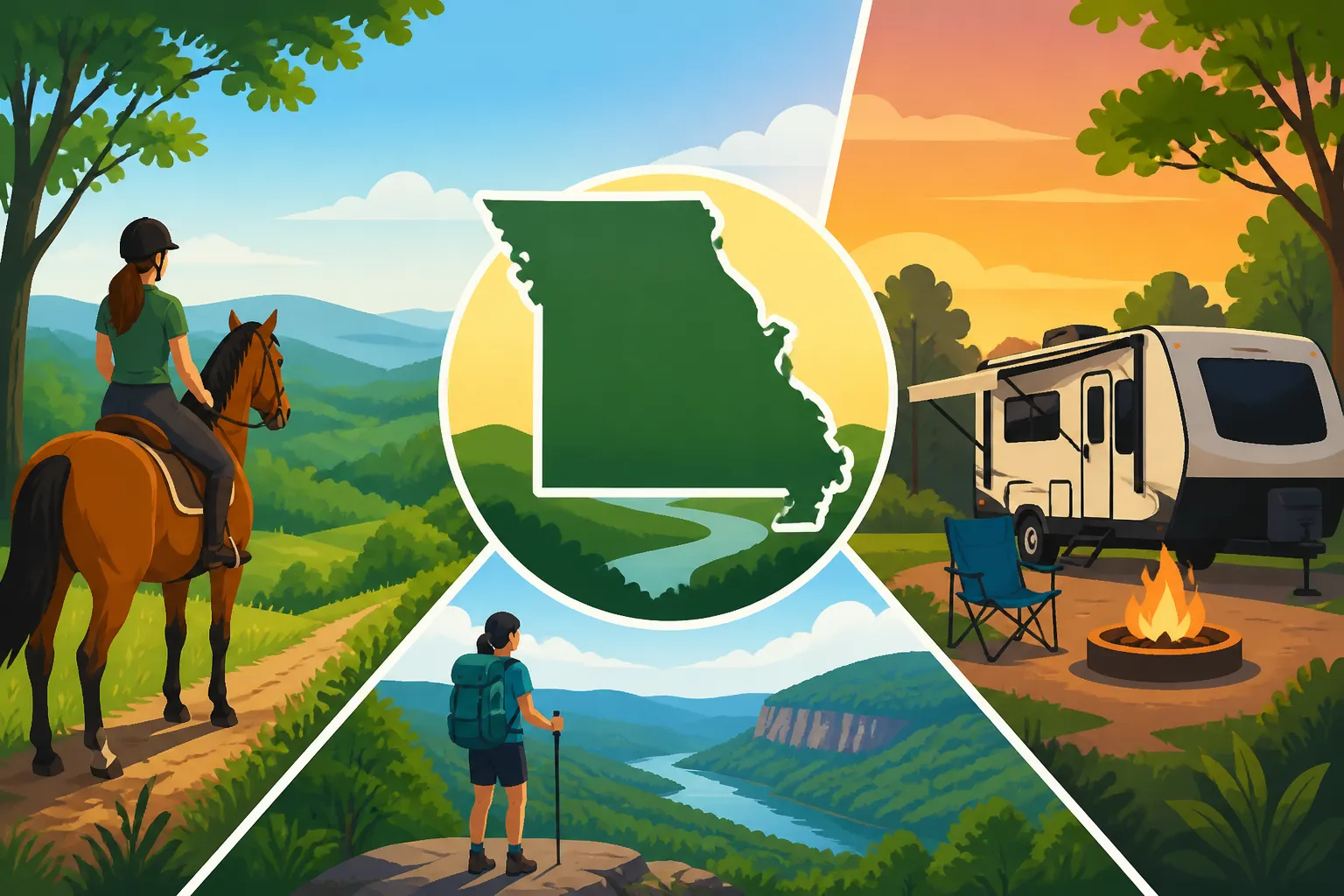
Equestrian, Backpack and Platform Sites: Specialty Camping in Missouri
Specialty campsites can make a trip fit the way you want to camp, but the labels do not tell you everything about access, setup or what to bring. Missouri state parks offer equestrian, backpack and platform tent options at select parks. Here’s how to compare them, identify what still needs checking and plan around the practical differences.
What Makes a Campsite a Specialty Site?
A specialty site is best understood as a site designed around a particular kind of camping or setup. The label can help narrow your search, but it is not a complete description of the campsite. It does not, by itself, tell you how far you will carry your gear, what equipment fits or which amenities are nearby.
For Missouri state parks, the three types covered here are:
- Equestrian camping: Camping associated with trips involving horses. Check the park’s listing for details about the campground and what it provides.
- Backpack camping: Overnight camping in designated areas along trails, reached on foot rather than by vehicle.
- Platform tent camping: A tent-site option identified as a platform tent site. Confirm the platform’s dimensions, surface and setup instructions before choosing your tent.
According to the Missouri Department of Natural Resources, backpack campsites are in designated areas along trails and are not accessible by vehicle. That access difference affects nearly every part of a backpacking plan: what you carry, how you pack it and how much comfort you can reasonably bring.
The Missouri Department of Natural Resources lists platform tent sites at Crowder, Cuivre River, Table Rock and Washington state parks. A listing tells you where this site type is available, but you should still read the individual park information to understand the exact setup.
According to the Missouri Department of Natural Resources, equestrian use can be found at Sam A. Baker; equestrian campgrounds are available at Sam A. Baker, Cuivre River, Johnson’s Shut-Ins and St. Joe state parks, and regular camping fees apply. The park-specific listing is the place to confirm what an equestrian campground includes and whether it suits your particular trip.
These options are not interchangeable. A platform site can change how you pitch a tent. A backpack site changes how supplies reach camp. An equestrian campground is intended for a trip involving horses, but the name alone does not confirm which horse-related facilities or rules apply. Treat the specialty label as a useful starting point, then verify the details that matter to your group.
For a broader look at how to compare locations and site types, see Camping in Missouri State Parks: How to Pick a Park and a Site. If you are still deciding between a standard campsite and a specialty option, the best choice depends on the access, equipment and camping style you are prepared to manage.
Compare the Three Site Types Before You Choose
A useful comparison starts with the trip itself, not with the most appealing campsite name. Think about who is traveling, what equipment you have, whether you need vehicle access at camp and how much uncertainty you are comfortable resolving before you arrive.
| Site type | Main planning question | What to confirm with the park | A good fit when |
|---|---|---|---|
| Equestrian | Does this campground fit the horse-and-camper group? | Horse-related facilities, site layout, permitted equipment and current rules | Your trip includes horses and the listed arrangements suit your group |
| Backpack | Can everyone carry the needed gear to the designated area? | Registration steps, route and site details, water availability and current conditions | You want a trail-based overnight and can plan for a non-vehicle-accessible site |
| Platform tent | Will your tent and setup work on the platform? | Platform dimensions, surface, tent placement and any site-specific instructions | You want a tent site with a platform and your equipment fits the stated setup |
The table is a planning aid, not a substitute for a park’s current site description. If a detail matters to safety or comfort, check it directly rather than inferring it from the campsite category.
Start with access
Access is often the clearest difference between these options. A vehicle-accessible site lets you bring supplies closer to where you sleep, while a backpack site requires you to plan around carrying them. Do not assume that a campsite is vehicle-accessible just because it appears in a campground search or has a reservation listing. Read the full description.
For backpack camping, picture the trip from the parking area to the site as part of your overnight plan. The amount and weight of your gear affect how manageable the walk feels. Pack only what the group needs, and make sure the people carrying shared supplies know what they are responsible for.
With equestrian camping, confirm how campers and horses are accommodated before you settle on a park. The label establishes that the campground is intended for equestrian use, but it does not answer practical questions about your horse, trailer or camp setup. If your group includes people who are not riding, ask whether the campground arrangement works for the whole party. The related article Equestrian Campsites in Missouri Parks: Can You Stay Without a Horse? focuses on that specific planning question.
With platform tent camping, check whether your vehicle can reach the site and how you move gear from the vehicle to the platform. The word “platform” does not answer whether the approach is level, whether there are steps or how much space is available around the tent. Those details can matter if you are carrying bulky gear or camping with someone who has mobility needs.
Match the site to your equipment
A site is only a good fit if your equipment works there. Backpackers need a load they can carry. Platform campers need a tent and pitching method that suit the platform. Equestrian campers need to confirm that their horse-related equipment and camping setup are permitted and practical at the specific campground.
For a platform site, do not assume every tent fits every platform. Check the listed dimensions and ask about the surface and how the tent is expected to be secured. A free-standing tent, a tent with a particular footprint or a shelter that needs stakes may interact differently with a platform. Confirm the park’s instructions before packing a setup that depends on a particular attachment method.
For backpacking, consider how every item affects the total load. Food, water, shelter, sleep gear and weather protection all take space and weight. The trail and site information should guide your plan, not a guess based on what you usually bring to a drive-up campsite. Use Backpack Camping in Missouri State Parks: Remote Sites, No Vehicles for a closer look at the access and planning considerations.
For equestrian camping, check the campground listing and ask about the gear and arrangements you expect to use. Do not assume the presence of an equestrian campground means a particular kind of trailer parking, horse accommodation or tie-up arrangement. Confirm what is available and what campers need to supply.
Think about the whole group
The site should work for everyone who will use it, not just the person who chooses it. Consider experience, comfort carrying gear, sleeping arrangements and how your group will handle the trip if weather or energy levels change.
A backpack site may not suit a group that is not prepared to carry its supplies. A platform tent site may be awkward if your tent, sleeping arrangement or mobility needs do not match the site. An equestrian campground may not fit a mixed group unless everyone understands the campground setup and the needs of the horses.
If your group includes children, older adults or people who need more support, plan around the least flexible needs first. Ask about the route from parking to the site, the walking surface, nearby facilities and any other detail that affects access. Do not use a general campground description as a substitute for confirming those details.
Planning an Equestrian Camping Trip
An equestrian campground can be a practical base for a trip built around horses, but the campground label is only the first check. Before committing, make sure the site and its arrangements fit both the horse-and-rider portion of your group and anyone joining as a non-rider.
Verify the horse-related arrangements
Start with the official listing for the particular park. Look for a clear description of what the campground provides, where the camping area is and what visitors are expected to bring. If the description does not answer your questions, contact the park through its official website to find current contact details.
Useful questions to resolve include:
- What horse-related facilities are available at the campground?
- What equipment or supplies should campers bring?
- How are trailers or other vehicles accommodated?
- Are there park-specific requirements for horses or riding?
- Does the campground’s layout fit your group’s camping equipment?
- Are any routes, facilities or areas temporarily unavailable?
- Where can you find the current rules that apply to the campground and trails?
These are questions to ask, not assumptions about what any park provides. Conditions and details can differ from one campground to another, so a description for one park should not be treated as the rule for another.
Plan for the entire party
A horse trip may include riders, non-riders and people who are not camping with the same equipment. Work out who is responsible for each part of the trip: horse care, food, shelter, camping gear and any vehicle or trailer logistics. A group plan is particularly useful when some people expect a riding-focused stay and others expect a standard campground experience.
Talk through the setup before arrival. Confirm how tents, vehicles and horse-related equipment are meant to fit within the site. If anyone in the group needs a particular route or facility, ask about it directly. A campground name is not enough to establish accessibility or suitability.
For a group choosing between horse camping and ordinary campsites, compare the options based on the full itinerary. A campground that suits the riders may not automatically be the most convenient base for every other activity. Think about where the group expects to spend time, what transportation is needed and what the park listing says about the specific site.
Keep fees and rules tied to the listing
According to the Missouri Department of Natural Resources, regular camping fees apply at equestrian campgrounds. That fact does not supply a specific price or tell you whether any additional costs or conditions apply to your stay. Check the park’s current official information for the amount due and any other charges relevant to your plans.
Do not infer horse rules from general camping information alone. Read the rules for the park, campground and any riding areas you plan to use. If one source is unclear or seems to conflict with another, ask the park to clarify before you travel. For a wider overview of campsite expectations, see Campground Rules at Missouri State Parks: A Practical Overview.
Planning a Backpack Campsite
Backpack camping is the option to consider when you want an overnight associated with a trail and are prepared to carry your equipment. It is also the option that calls for the most careful thinking about what happens between the vehicle and the campsite.
Plan the walk as part of the campout
Because backpack campsites are not accessible by vehicle, everything needed at camp has to be carried from wherever you begin the walk. That does not mean you should guess the route, distance or conditions. Check the park’s official information for the designated area and the approach, then confirm any current notices that could affect your plans.
Before setting out, make a realistic gear list. Include shelter, sleep gear, food, water, weather protection, lighting and a way to manage waste according to the park’s directions. Separate shared gear from individual gear so the load can be divided fairly. If one person carries most of the group’s supplies, the plan may become difficult if that person gets tired or needs to turn back.
Avoid packing for a drive-up campground and assuming the same load will work on foot. Items that are convenient beside a vehicle can be unnecessary weight on a trail. On the other hand, reducing weight should not mean leaving behind something essential for the conditions or the group’s needs. Use the park’s information and your group’s experience to balance comfort and load.
Confirm site and registration details
The term “backpack campsite” does not tell you how to register, whether a permit or other step applies, where to leave a vehicle or how the site is marked. Confirm those details with the park before departure. Do not rely on a map image or a general description if the official information gives a more specific process.
Check what the park says about water and facilities. Do not assume a water source is available at the site or along the route. If the listing does not clearly explain water access, ask the park and plan accordingly. Your water plan affects how much you carry and whether the route is manageable for your party.
Check the current park status and trail information close to travel. A route or campsite can be affected by temporary conditions, and an old description may not reflect a current closure. Checking a Missouri State Park’s Status and Closures Before You Go is useful when you want to verify alerts before setting out.
Leave room for changing conditions
A backpacking plan benefits from a realistic backup. Consider what the group will do if someone cannot continue, weather changes or the approach is not as expected. Keep your plan flexible enough to respond without relying on a site feature or route condition you have not confirmed.
Tell someone outside the group where you plan to go and when you expect to return. Carry the information you need to follow the park’s registration instructions and find your designated area. Keep the plan focused on the actual trip rather than treating a backpack campsite as a secluded drive-up alternative.
If this will be a first backpack overnight, consider whether every member of the group is ready to carry a full camping load. A shorter outing or a more accessible campsite may be a better introduction. For a state-park option that still involves a walk from the vehicle, see Hawn State Park’s Pine Woods: Walk-In and Backpack Camping, while keeping in mind that site arrangements are park-specific.
Planning for a Platform Tent Site
A platform tent site can be appealing if you want to camp in a tent but prefer the site type identified by the park as a platform. The main job before booking is to make sure your tent, setup method and group’s needs suit the particular platform.
Check the site description, not just the category
The Missouri Department of Natural Resources lists platform tent sites at Crowder, Cuivre River, Table Rock and Washington state parks. That list helps you identify parks to research, but it does not establish that every platform site has the same dimensions, surface, layout or nearby facilities.
Read the specific site information and look for details about:
- Platform dimensions and shape
- The surface and how the tent may be secured
- The route from the parking area to the site
- Space for other camping equipment
- Nearby restrooms, water or other facilities
- Any site-specific setup instructions
If those details are missing, ask the park before choosing a tent. Do not assume that a platform’s size is standard across parks or that your usual tent setup will work without adjustment.
Test your tent plan before travel
If possible, check your tent’s footprint and setup requirements against the platform information before you pack. Think about where the tent door will open, whether the sleeping layout fits and where other equipment can go. A tent may technically fit but leave little room for entry or everyday movement.
Consider the ground conditions around the platform as well. The platform does not necessarily provide space for every item you would normally place beside a tent. Ask whether the park has instructions about equipment placement or securing the shelter, and follow those instructions rather than improvising at the site.
Pack a setup that can be used within the park’s stated requirements. If your tent depends on stakes or a specific footprint, verify that the method is appropriate for the platform. Do not plan on attaching equipment in a way the park has not approved.
For park-specific information, compare Platform Tent Camping at Crowder State Park, Cuivre River State Park Camping: Walk-In, Platform and Group Sites and Table Rock State Park Campgrounds: Platform Tents, Yurts and Season. These focused topics can help you continue researching the parks, but confirm current details for the site you intend to use.
Account for access and comfort
A platform does not tell you whether the site is close to parking, level on the approach or easy to reach with bulky gear. If anyone in your group has mobility needs, ask about the route and facilities. If you are bringing children or carrying equipment by hand, confirm how gear gets from the vehicle to the platform.
Think through rain and changing weather as well. Check the park’s setup guidance and prepare a way to keep sleeping gear and supplies protected. A platform changes the tent’s placement, but it does not remove the need to plan for weather, ventilation and keeping equipment organized.
How to Research and Confirm a Specialty Site
Good planning means turning a broad site label into a clear picture of the actual stay. Use the official state park information for the selected park, then resolve any details that could affect access, safety, equipment or cost.
Use a focused verification process
- Choose the camping style first. Decide whether your priority is horse-related camping, a trail-based overnight or a tent platform. Do not choose based only on a park name or a photograph.
- Identify parks that list the site type. Use the park information to find the available option, then open the details for the campground or site itself.
- Check the approach. Confirm whether you can drive to the site, need to walk with gear or need to coordinate vehicles and horse equipment.
- Match your equipment. Verify tent fit, camping gear, trailer arrangements or pack weight as relevant.
- Read current rules and alerts. Check the park’s official information for restrictions, closures and instructions that could affect the trip.
- Resolve unanswered questions. Use the park’s official website to find current contact details and ask about any important uncertainty.
- Recheck before leaving. Conditions and information may change between planning and travel, so review the park’s current notices before departure.
This process is deliberately practical: a single detail can change the right choice. A backpack site that requires more carrying than your group can manage is not a good fit simply because the setting looks appealing. A platform site that does not suit your tent can complicate arrival. An equestrian campground that lacks a confirmed arrangement your group needs may not be workable.
For reservation steps, use How to Book a Missouri State Park Campsite Online or by Phone. Before completing a booking, make sure you are selecting the intended campsite type and understand the park’s current terms. Do not assume that the reservation label answers questions about equipment, access or facilities.
Keep a written list of what you confirmed
It is easy to remember the broad plan and forget a specific detail. Keep a short note with the park, campground or site name, the access instructions, equipment requirements and any current notices you need to follow. For a group, share those details with everyone making decisions or carrying supplies.
A written list is especially useful when a trip involves more than one kind of equipment. Equestrian campers may be coordinating camping gear and horse-related gear. Backpackers may be dividing shared food, shelter and water. Platform campers may need to bring a tent that fits the site’s stated setup.
Keep the park’s directions available during the trip, but do not treat an old saved copy as proof that conditions remain unchanged. Check again close to departure and follow current notices on arrival. If a park changes an arrangement or closes an area, revise the plan rather than trying to make an unsuitable site work.
Pack for the site you booked
A general camping checklist can be a useful starting point, but adapt it to the campsite category and the park’s instructions. For a backpack trip, prioritize a manageable carry. For a platform site, confirm that the tent and its setup method fit. For an equestrian stay, confirm the horse-related arrangements and supplies with the park.
Camping Gear Checklist for a Missouri State Park Weekend can help you build a general packing list. Then remove anything that does not suit your site and add what the park specifically requires or recommends. A checklist is a prompt, not a substitute for reading the campsite description.
Frequently Asked Questions
Which Missouri state parks list platform tent sites?
The Missouri Department of Natural Resources lists platform tent sites at Crowder, Cuivre River, Table Rock and Washington state parks. Check the individual park listing for the details of the site you are considering.
Can I drive to a backpack campsite?
No. Missouri Department of Natural Resources information says backpack campsites are not accessible by vehicle. Confirm the designated area, approach and any registration instructions with the park before you go.
Which parks have equestrian campgrounds?
The Missouri Department of Natural Resources lists equestrian campgrounds at Sam A. Baker, Cuivre River, Johnson’s Shut-Ins and St. Joe state parks. Check each park’s official information for the specific arrangements.
Do equestrian campgrounds have a different camping fee?
The Missouri Department of Natural Resources says regular camping fees apply at equestrian campgrounds. Check the selected park’s current official information for the amount and any other applicable details.
Sources
- Missouri Department of Natural Resources — Guide to Campsites | Missouri State Parks (checked November 23, 2026)
Disclaimer
This article is for general informational purposes only and does not constitute professional advice. Laws, prices and regulations vary by location and change over time. Consult a qualified professional for guidance on your specific situation. Missouri Camping & RV is not a government agency and is not affiliated with any government agency.