Campground Rules at Missouri State Parks: A Practical Overview
Missouri state park campground rules can be easy to overlook when you are focused on choosing a site, packing gear, and planning the drive. The key is to separate statewide requirements from details you need to confirm for a particular campground. This overview explains what to check, how to prepare, and what to do when a rule is unclear.
Start by Identifying Which Rules Apply
A campground visit can involve several layers of information: rules that apply across Missouri state parks, instructions for a particular park, and details tied to an individual campsite or lodging unit. Do not assume that a practice allowed at one campground is automatically allowed at another. Before you travel, check the official information for the park and the specific place you plan to stay.
This is especially useful when a trip involves an unusual setup, such as a trailer, multiple tents, a pet, a group, or a site outside the standard campground loop. A general campground overview can help you identify questions, but the listing and current instructions for your location are the places to confirm the answer. For help choosing a location and site type, see Camping in Missouri State Parks: How to Pick a Park and a Site.
It also helps to distinguish a rule from a facility description. A listing may tell you what a site includes, such as a particular hookup or a nearby facility; that information does not necessarily answer where you may park, how you may arrange equipment, or what activities are allowed. Read both the description and the rules, and look for details that specifically match your visit.
Use this simple check before you leave:
- Confirm that the park and campground are open for your planned visit.
- Read the site description and any notes attached to the reservation.
- Look for current notices about closures, construction, or changed access.
- Check rules that matter to your setup, including vehicles, pets, fires, and visitors.
- Save the official information somewhere you can access after arriving.
For status and closure checks, see Checking a Missouri State Park’s Status and Closures Before You Go. A confirmed reservation or a site that appears available on a calendar does not, by itself, answer every question about current access or campground conditions. Check the official park information close to departure, and look again when you arrive if notices have been posted.
| Topic | What to confirm before the trip | Why it matters |
|---|---|---|
| Site and setup | Site type, sleeping setup, and any listed limitations | The site description may not answer every use question |
| Vehicles | Where your vehicle, trailer, and other wheeled equipment may go | Staying on the permitted surface helps avoid damage and conflicts |
| Belongings | How long personal property may remain unattended | Gear left behind can create a campground management issue |
| Fire | Current park instructions and any fire-related restrictions | Conditions and restrictions can change |
| Pets and visitors | The rules for the places and facilities you plan to use | Permission in one area does not establish permission everywhere |
| Arrival and departure | Check-in, checkout, and late-arrival instructions | A plan for timing prevents confusion at the site |
The table is a planning prompt, not a substitute for official rules. If a row raises a question, look for an answer in the park’s current information or ask park staff through the contact details on the official website. Avoid relying on an old screenshot, a general recollection, or a rule described for a different campground.
Place Vehicles and Trailers Where They Belong
Where a vehicle or trailer is parked can affect the campsite surface, neighboring sites, traffic flow, and access for other visitors. Treat the designated road and parking pad as the default places for wheeled equipment, rather than assuming the open ground beside a site is available for parking.
The Missouri Department of Natural Resources’ rule for wheeled vehicles and trailers is: kept on roads and parking pads except as otherwise permitted by special management regulations.
In practice, that means checking the layout before you pull into a site. Look for the road, the parking pad, and the area intended for camping. If your vehicle, trailer, or the way you need to maneuver does not seem to fit, do not solve the problem by driving onto nearby ground. Check the park’s instructions or ask staff where an exception may apply.
A few details are worth sorting out before arrival:
- Vehicle length and turning room: Consider whether your vehicle and trailer can enter, park, and leave without using an unapproved area. Site dimensions or layout information may help, but confirm anything that is unclear.
- More than one vehicle: Do not assume every site has room for extra vehicles. Confirm whether the site description or campground instructions address them.
- A second trailer or towed vehicle: Check how the park treats each part of your setup. A vehicle that is easy to position at home may need a different plan at a campground.
- Parking away from the site: If the pad cannot accommodate your setup, ask about the permitted alternative rather than choosing a spot on your own.
- Temporary loading and unloading: Follow posted directions and avoid blocking campground roads or another site while handling gear.
Site types can differ in their layout and amenities, so compare the listing with your actual equipment. Missouri Campsite Types Explained: Basic, Electric and Full Hookup can help you understand common listing terms, while Will Your RV and Tow Vehicle Fit a Missouri State Park Campsite? is useful if the dimensions or maneuvering space are uncertain.
The practical goal is not to make a tight fit work at any cost. It is to arrive with a realistic plan that keeps wheels on the permitted surface and leaves the campground usable for others. If you discover that your setup does not fit, pause and ask for direction. Driving over grass or another unmarked area to make space can turn a small logistics problem into a rule or site-impact problem.
Do not treat an apparent empty patch as permission. A grassy shoulder, an adjacent site, or a clear area beyond a pad may look convenient, but its appearance does not establish that vehicles or trailers may use it. If special management regulations may allow a different arrangement, confirm that permission for the particular location before using it.
Keep Personal Belongings From Becoming a Problem
Campers bring plenty of property to a site: tents, chairs, coolers, cooking gear, bicycles, and equipment for recreation. The useful distinction is between belongings that are part of an active stay and property that is left behind after the camper has gone. Plan what you will take with you whenever you leave the campground, and do not use a site as storage between visits.
According to the Missouri Department of Natural Resources, personal property may not be left unattended for longer than 24 hours.
That rule is a reason to make a departure plan before a long outing, not only at checkout. If you expect to be away from the campground, decide whether the belongings you leave are part of your continuing stay and whether the park’s directions allow that arrangement. If you are ending your stay or moving elsewhere, take your gear with you rather than assuming it can remain at the site.
A practical approach is to keep your campsite organized enough that you can tell what belongs to your group and what needs to go. Secure loose items before leaving, but do not mistake securing them for permission to leave them unattended beyond the allowed period. If a plan involves leaving equipment while you travel, ask park staff how the rule applies to your situation.
This issue can come up in several ordinary scenarios:
- A day trip away from camp: Decide which belongings you need to bring and which may remain during your outing. Check the park’s directions if you expect an extended absence.
- Moving between parks: Pack and remove your belongings as part of the move. Do not assume a reservation at another location permits you to leave property behind at the first one.
- A delayed departure: If a vehicle problem, weather, or another unexpected situation changes your plan, contact park staff for direction rather than letting property sit without explanation.
- Leaving equipment for a group: Make sure someone in the group understands who is responsible for the site and belongings, and confirm the arrangement with park staff if it is unusual.
- Packing out: Before leaving, check the site for items that can be overlooked, including small gear, food containers, and personal belongings.
Personal property includes more than large camping equipment. A chair, cooler, or item left beside a site can still be someone’s belongings. Keep gear within the area you are authorized to use, and avoid placing it where it blocks roads, access, or another camper’s space. Where an item may be stored or left while you are away is a question for the park’s instructions, not something to infer from available room.
If you are planning a longer trip or trying to stretch a visit across multiple locations, think through the logistics before booking. Moving Between Parks in Missouri to Extend a Camping Trip can help with the broader planning question. For rules about leaving items at an outdoor site, see Leaving Gear at a Forest Campsite in Missouri: The Equipment Rule; do not assume that guidance for another kind of public land automatically applies inside a state park.
Confirm Your Site Setup Before You Unload
A reservation gives you a destination, but the site description and campground instructions determine what to expect there. Before packing, compare the listing with the equipment and sleeping arrangement you intend to use. If you are bringing an RV, tent, trailer, or several pieces of gear, make sure the site type suits that setup and that you understand where the equipment may be placed.
The words used to describe a site are not a substitute for checking its specific features. A campground may have more than one kind of site, and details can differ even within the same park. Check the official listing for the site you selected rather than relying on a nearby site’s appearance or on a description from another location.
Use the reservation details as a checklist:
- Does the site description match the type of camping unit you are bringing?
- Does it identify the amenities you expect to use?
- Does the physical layout appear suitable for your vehicle and equipment?
- Are there notes about access, seasonal availability, or limitations?
- Do any park instructions address tents, trailers, extra vehicles, or other gear?
If an important detail is missing, ask before you travel. It is easier to adjust equipment or choose a different site beforehand than to discover at arrival that your setup does not suit the space. Avoid treating an image, map symbol, or broad category as a guarantee of every feature you need.
The same care applies when a site is shared by a group. Discuss who is bringing each sleeping unit, vehicle, or piece of large equipment, then compare the combined setup with the site information. A plan that works for one camper may not work for a group, even if everyone has an individual reservation or expects to gather at the same location.
For a practical overview of campground expectations, see Campground Rules at Missouri State Parks: A Practical Overview only if you are reading a different article; for this topic, use the official park and campsite information as your reference. If you are camping with children, Kids, a Tent and a Missouri State Park: Planning a Family Campout can help with preparation, while Rookie Mistakes at Missouri State Park Campgrounds may help you catch overlooked logistics.
Do not build the whole plan around a feature you have not verified. If access to a particular facility, water source, or showerhouse is important to your stay, look up its current availability for the dates you plan to visit. Seasonal operations and temporary changes can affect what is usable, so confirm the current information instead of assuming that a feature will be available because it was open on a previous trip.
Check Fire, Pet, Visitor, and Conduct Rules Separately
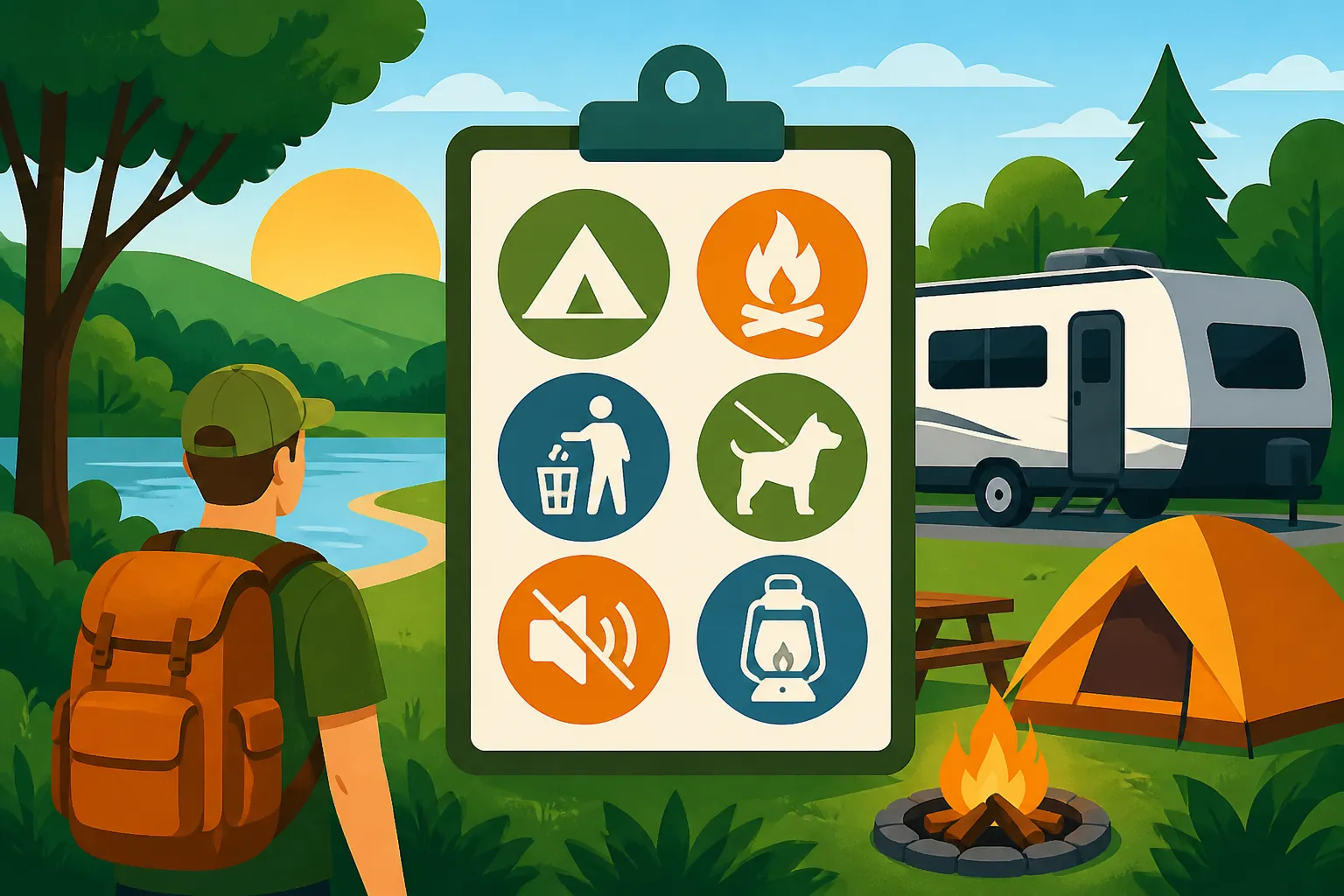
Some campground questions are easy to miss because they concern what you do after setting up rather than where you sleep. Fire use, pets, visitors, noise, waste, and recreation can each have their own directions. The safest planning habit is to check the relevant rule for the park and the specific area you intend to use.
Fire rules and changing restrictions
Do not infer that a fire is permitted simply because a site has a fire ring, grill, or other fire feature. The presence of equipment does not tell you whether a fire may be used under current conditions or what materials and devices are allowed. Check the park’s current fire instructions and any applicable restriction before you go, then check again when you arrive.
Fire restrictions and bans can change. The useful action is to look for current information from the Missouri Department of Natural Resources or the official park information, not to rely on a general statement that a restriction is or is not active. Check before you leave and again on arrival. If the notice is unclear, do not guess; ask park staff what applies at your site.
For a focused explanation of where to look and how to interpret the relevant guidance, see Checking Burn Bans and Fire Danger Before a Missouri Camping Trip and Where Are Campfires Allowed at Missouri State Parks?. These topics help frame the questions to ask, but the current official notice remains the basis for your decision.
Pets and areas of use
If you are bringing a pet, check the park’s rules for the campground and for every other area you plan to visit. Permission to stay with a pet at a campsite does not automatically answer whether the animal may enter a building, swimming area, trail, or lodging unit. Look for details that match both your destination and your type of stay.
Prepare to follow posted directions and keep your pet under control in shared areas. Pack the supplies you need to manage the animal and clean up after it, and plan an alternate activity if a destination does not permit pets. For a fuller planning overview, see Bringing Your Dog to a Missouri State Park: Cabins, Trails, Etiquette and Pet Rules at Missouri Campgrounds: State Parks vs. Conservation Areas.
Visitors, noise, and shared spaces
If friends or family may visit your campsite, check the park’s visitor and access instructions before making plans. Do not assume that a visitor may arrive at any time, use any nearby parking area, or stay overnight. The campground’s current directions are the right place to confirm what is allowed.
Be considerate with noise and shared facilities even when a particular detail is not spelled out in the material you have read. Keep your setup from spilling into travel routes or adjacent sites, and leave room for other campers to move around. Treat posted quiet or conduct instructions as park rules, and ask staff if a situation is not covered clearly.
Waste, food, and cleanup
Look for the park’s directions for trash, wastewater, food storage, and cleanup. Do not decide that a disposal method is acceptable simply because it is convenient or because you have used it elsewhere. Facilities and instructions can differ, and the correct option depends on the location and the type of waste.
Food and scented items are another reason to consult the specific guidance for the place you are visiting. Camping in Missouri Bear Country: A Food Storage Guide explains why food storage deserves its own planning step. Follow the applicable park directions rather than applying a rule from a different property or campground.
Make Arrival, Stay, and Checkout Easier
Knowing the rules is only part of a smooth stay; it helps to have a practical routine for using them. Before departure, put the important information where everyone in your party can find it. Share the site location, setup plan, and any rules that affect the group. That way, the person driving the trailer is not the only one who knows where it belongs, and a visitor is not left guessing about access.
At arrival, pause before unloading. Compare the site with the information you reviewed, find the parking pad and intended camping area, and check for posted notices. If the site looks different from its description or your setup cannot be placed as planned, ask for direction before moving equipment onto an unapproved area.
During the stay, keep track of belongings and departures. If someone leaves the campground, agree on what equipment stays and who is responsible for it. If an unplanned absence changes the arrangement, contact park staff. This is particularly helpful when a group has several vehicles or when some people are using the campground while others are away.
At checkout, take a deliberate walk through the area. Gather your belongings, remove waste through the method the park specifies, and make sure no gear has been left behind. Follow the official checkout directions for the site and any facilities you used. For timing and departure expectations, see Check-In and Checkout at Missouri State Park Campgrounds.
If you arrive late or expect a delay, do not assume that the entrance, campground, or site will be available in the way you expect. Review the park’s late-arrival and access information before the trip. Gate Hours at Missouri State Parks: How to Find Them and Arriving After Dark at a Missouri Campground: Checking In Online can help you identify what to verify.
Keep the official information handy after arrival. A screenshot can be useful if the campground has limited cell service, but save the information while you have access and confirm that it is current before traveling. A screenshot is a reference, not proof that a temporary notice has not changed. Check posted notices and contact park staff when an instruction conflicts with what you saved.
What to Do When a Rule Is Unclear
An unclear rule is a reason to pause, not an invitation to choose the interpretation that is most convenient. Identify the exact issue, check the official park information, and ask staff for clarification if the answer is not there. That might mean asking where a trailer may be positioned, whether a specific part of a site can be used, or how a current fire notice applies.
When you ask, describe the situation rather than asking only a broad question. Include the type of equipment, the site you are using, and what you are trying to do. A precise question is more likely to produce an answer you can apply. If the answer depends on a special management regulation or a temporary condition, make sure the staff member is addressing your actual location and circumstances.
Avoid relying on informal advice as the final word. A social post, a comment from another camper, or a rule remembered from another park may be useful as a prompt for what to check, but it does not establish what applies to your site. The same goes for signs or facilities at a different campground. Use the park’s official information and on-site directions.
If two pieces of information seem to conflict, do not pick one at random. Check whether one is a general rule and the other is a location-specific instruction, or whether one may be outdated. Ask park staff to reconcile the difference before acting. This is especially important when the choice could affect vehicle placement, fire use, access, or property left behind.
A good decision process is straightforward:
- Find the exact wording or instruction that raises the question.
- Check whether it refers to the park, campground, site type, or a particular area.
- Look for a more recent notice or a specific exception.
- Ask staff if the answer remains uncertain.
- Follow the direction that applies to your situation and keep the setup within the permitted area.
That approach may take a little extra time, but it prevents avoidable confusion after you have unloaded. It also helps you plan a useful backup: a different way to position equipment, a different activity with a pet, or a revised arrival plan. When a rule cannot be confirmed, choose the option that avoids creating an impact while you seek clarification.
Frequently Asked Questions
Can I park a trailer on open ground beside my campsite?
Do not assume that open ground is available for parking. The Missouri Department of Natural Resources’ rule directs wheeled vehicles and trailers to roads and parking pads unless special management regulations permit otherwise. Check the park’s instructions if your setup does not fit.
Can I leave my camping gear at the site while I go away?
The Missouri Department of Natural Resources says personal property may not be left unattended for longer than 24 hours. If your plans involve an extended absence or an unusual arrangement, ask park staff how to handle it.
Does a fire ring mean I can have a campfire?
Not by itself. Check the current instructions for the park and campground before leaving and again when you arrive, because fire restrictions can change. Ask staff if the notice does not make clear what is permitted.
Are the same rules used at every Missouri state park campground?
Do not assume every detail is identical. Use statewide guidance as a starting point, then confirm the current directions for your park, campground, and site.
Where should I check if the campground information is unclear?
Start with the official park information and current on-site notices. If they do not resolve the question, contact park staff using current details from the official website.
Sources
- Missouri Department of Natural Resources — Camping Rules | Missouri State Parks (checked November 23, 2026)
Disclaimer
This article is for general informational purposes only and does not constitute professional advice. Laws, prices and regulations vary by location and change over time. Consult a qualified professional for guidance on your specific situation. Missouri Camping & RV is not a government agency and is not affiliated with any government agency.